For a long time, success was easy to measure.
A good job. A bigger salary. A nice car. A beautiful house. A promotion that came with a better title and a better paycheque.
And there is nothing wrong with any of these things.
But something is changing.
More people are beginning to ask a different question:
“What happens if my income stops tomorrow?”
That question changes the way you think about success.
Because earning well is not necessarily the same as building wealth. Having money coming in every month is different from owning things that continue to create value even when you are not actively working for every naira.
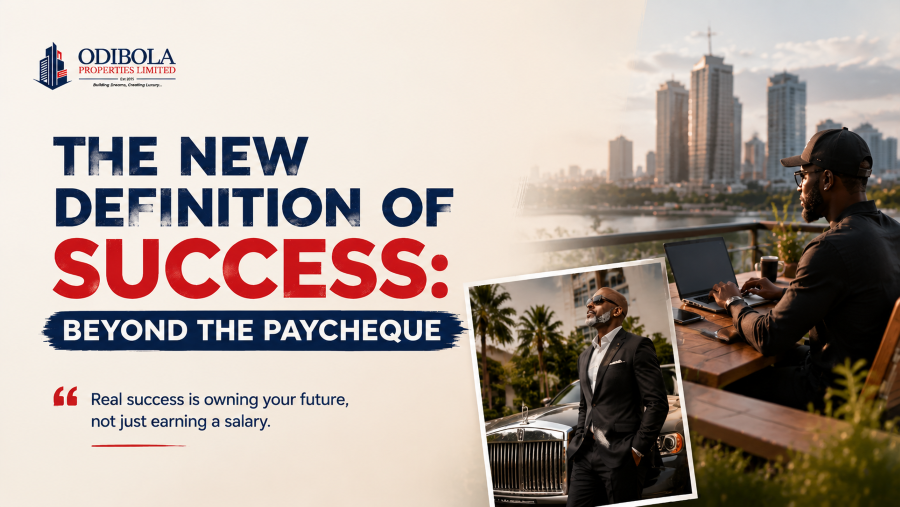
The new definition of success is increasingly about ownership, options and financial independence.
It is about building a life where your future is not entirely dependent on your next salary.
A Paycheque Can Give You Comfort. Ownership Can Give You Options.
Your salary can pay the bills.
It can fund your lifestyle, support your family, pay school fees and help you enjoy the things you have worked hard for.
But a salary is still an income stream.
If you stop working, the income may stop too.
This is why financially intentional people think beyond earning. They think about what they can own, build and multiply.
That could be a business.
It could be an investment portfolio.
It could be intellectual property.
It could be shares in a company.
It could be property.
It could be a digital business, professional skill or personal brand that generates income beyond traditional employment.
The goal is not necessarily to quit your job.
The goal is to avoid making your job your only financial engine.
Entrepreneurship Is No Longer Only About Starting a Company
When people hear entrepreneurship, they often imagine someone leaving their nine-to-five job, renting an office and starting a company.
But entrepreneurship can be much broader than that.
It is the mindset of creating value and taking ownership.
A professional who turns their expertise into a consulting business is an entrepreneur.
Someone who builds a content platform around their knowledge is creating an asset.
A person who develops a product and sells it online is building a business.
Someone who invests consistently while maintaining their career is also taking a different approach to wealth creation.
The modern professional does not necessarily have to choose between employment and entrepreneurship.
Sometimes, the smartest approach is to earn, learn, invest and build at the same time.
Your job can provide income.
Your business can provide another income stream.
Your investments can grow your capital.
Your assets can appreciate over time.
Together, they create something much stronger than a single source of income.
Multiple Income Streams Are About Resilience, Not Greed
There is a lot of conversation about having multiple income streams.
But the real value is not simply making more money.
It is creating financial resilience.
Imagine two people earning the same amount every month.
Person A receives everything from one salary.
Person B earns from a salary, a small business, investments and an asset that generates additional income.
They may have the same monthly income today, but they do not have the same level of financial resilience.
If one source becomes unavailable, Person B has other options.
That is the real power of diversification.
However, multiple income streams should not mean chasing every opportunity you see.
You do not need ten businesses.
You need a thoughtful combination of income-producing activities and assets that you understand.
Build deliberately, not desperately.
Assets Change the Conversation
There is a major difference between spending money and deploying money.
When you spend, the money leaves you in exchange for something you consume.
When you invest in an asset, you are putting money into something that you hope will retain or increase its value, generate income, or both.
That distinction can completely change your financial decisions.
The question becomes:
“What am I getting in return for this money?”
Not every purchase needs to produce financial returns. Life is also meant to be lived.
But if every increase in income immediately becomes an increase in lifestyle expenses, your financial position may not improve significantly.
The person who earns more but owns nothing may remain financially vulnerable.
The person who gradually converts part of their income into productive assets is building a different future.
Financial Independence Starts With Small Decisions
Financial independence sounds like a destination reserved for wealthy people.
It is not.
It begins with ordinary decisions.
Saving before spending.
Investing consistently.
Avoiding unnecessary debt.
Learning how money works.
Building valuable skills.
Creating additional income.
Owning productive assets.
Making decisions based on long-term goals rather than short-term pressure.
You may not be able to transform your finances overnight.
But you can change the direction of your finances today.
And direction matters.
Think in Years, Not Just Months
One of the biggest differences between short-term financial thinking and long-term wealth thinking is the question being asked.
Short-term thinking asks:
“What can I afford today?”
Long-term thinking asks:
“What can this decision do for me five or ten years from now?”
That does not mean every decision should be postponed in the name of the future.
It means your future should have a seat at the table.
A young professional might decide to invest part of their income instead of upgrading their lifestyle every time they receive a raise.
A business owner might reinvest profits into expansion instead of taking everything out.
A family might begin acquiring assets gradually, knowing that the real benefit may become clearer years later.
This is how wealth is often built.
Not through one dramatic decision, but through consistent decisions repeated over time.
Ownership Looks Different for Everyone
Ownership does not have one definition.
For one person, it could mean owning a business.
For another, it could mean building a property portfolio.
For someone else, it could mean owning financial investments, developing intellectual property or creating a personal brand that generates revenue.
The important question is:
“What am I building that can outlive my next paycheque?”
This is where the conversation around real estate becomes relevant.
Property is one of the ownership routes many Nigerians consider because it can provide exposure to a physical asset while potentially benefiting from long-term development and appreciation.
Companies such as Odibola Properties represent one example within that broader ownership conversation. Through property developments and investment opportunities, the idea is not simply about buying a piece of land or a building. It is about thinking differently about where part of your money can sit over the long term.
Of course, every investment comes with risks, and no asset should be presented as a guaranteed path to wealth.
The bigger lesson is the mindset behind ownership.
Do not only ask how much you can earn. Ask what you can own.
What Can You Start Building Today?
You do not need millions of naira to begin thinking differently about success.
Start with what you have.
1. Build a valuable skill
Your ability to solve valuable problems can become one of your greatest assets.
Invest in skills that can increase your earning potential, create opportunities or eventually become a business.
2. Build an emergency fund
Before aggressively pursuing investments, create some financial breathing room.
Having money set aside for unexpected expenses can prevent you from liquidating investments or taking expensive debt when life happens.
3. Build a second income stream
Start small.
Freelancing, consulting, tutoring, digital services, content creation or a small business can become additional sources of income when approached seriously.
4. Start investing consistently
You do not need to wait until you are wealthy before learning to invest.
Start with instruments you understand, consider your risk tolerance and seek appropriate professional advice where necessary.
Consistency can matter more than trying to find the perfect investment at the perfect time.
5. Start acquiring assets
Think about what you can gradually own.
Depending on your circumstances, that might include financial assets, business interests, intellectual property or real estate.
The objective is to move gradually from consumer to owner.
6. Build your network
Your network can become an invisible asset.
Meet people who are building businesses, creating investments, developing skills and thinking differently about money.
The conversations you have today can introduce you to opportunities you would not have discovered alone.
7. Give your money a long-term assignment
Do not let every naira you earn have only a short-term purpose.
Some money should pay today’s bills.
Some should protect your future.
Some should be invested.
Some should help you build.
That balance is where intentional financial planning begins.
Success Is Becoming Less About Looking Rich and More About Becoming Free
Perhaps the biggest shift in the definition of success is this:
Success is not simply how much you can afford to show. It is how much freedom you are gradually creating.
Can you make choices without being completely controlled by your next salary?
Can you take a calculated risk?
Can you survive an unexpected financial setback?
Can you create opportunities for yourself?
Can the things you have built continue to create value years from now?
Those questions matter.
The new definition of success is not about rejecting the paycheque.
It is about refusing to let the paycheque be the end of the story.
Earn. Build. Own. Invest. Think long-term.
Because at some point, the goal should move from simply making money to building something that gives your money, your time and ultimately your life more options.
And perhaps that is what success really looks like today:
Not just having more money, but having more choices.