A beautiful building can attract attention.
Good architecture can make people stop and look. Quality finishing can create a strong first impression. A great location can make a property even more attractive.
But none of these things can answer one important question:
Can I trust the people behind this property?
That question matters because real estate involves more than buildings.
It involves people’s money.
It involves family plans, business goals and personal dreams. For many buyers, purchasing property takes years of saving and careful planning.
So, when someone chooses a property company, they are not only choosing a building.
They are also choosing the people who will guide them through the process.
That is why customer service in real estate matters.
A Property Purchase Is a Personal Decision
Buying property is rarely an impulse decision.
A buyer may spend weeks asking questions before making a commitment. They may visit a property more than once. They may speak with family members. They may compare different options.
Some buyers also live outside the city or outside Nigeria.
For them, clear communication becomes even more important.
They need to know what they are buying. They need to understand the process. They need someone they can contact when they have questions.
This is where customer service begins.
It begins with listening.
It continues with clear answers.
Most importantly, it requires follow-through.
Trust Starts Before the Payment
Trust should not begin after a client makes payment.
It should start with the first conversation.
A good property consultant does not need to pressure every prospect into buying immediately. Instead, the consultant should understand what the person wants and provide useful information.
For example, a buyer may want to know the location of a property before discussing price.
Another person may want to understand the payment structure.
Someone else may want to inspect the property before making any decision.
Each person deserves a clear response.
That sounds simple, but it makes a difference.
A client who feels heard is more likely to ask better questions. A client who receives clear information can make a more informed decision.
In the long run, that creates stronger relationships.
Good Service Is About What Happens After the Sale
One major mistake in real estate is treating payment as the end of the relationship.
For the client, payment may actually mark the beginning of another stage.
There may be documentation to complete.
There may be an inspection to arrange.
There may be allocation details to understand.
Later, there may be handover.
Each stage creates another opportunity to serve the client well.
At Odibola Properties, these parts of the customer journey matter.
A client should know what happens next.
They should know who to speak with when they need clarification.
They should also receive updates when a process requires their attention.
These details may not appear in a property photograph.
However, they can shape the way a client remembers the entire experience.
Clear Communication Can Prevent Bigger Problems
Good communication does not mean telling clients what they want to hear.
It means giving them information they can understand and act on.
Sometimes, the answer is straightforward.
At other times, a team member may need to confirm information before responding.
In that situation, saying “Let me confirm that for you” can be better than giving an uncertain answer.
The important part is what happens next.
The team should return with the correct information.
That simple habit can prevent confusion.
It can also protect the relationship.
For a property company, clarity is not just a communication skill. It is part of responsible service.
Integrity Becomes Visible When Things Get Difficult
It is easy to talk about integrity when everything goes according to plan.
The real test comes when something requires attention.
A client may have a question about a document.
A project update may take longer than expected.
A buyer may need clarification about the next stage of the process.
These moments require patience.
They also require honesty.
Instead of avoiding a difficult conversation, a responsible company should address it.
If the team needs more time to investigate something, it should say so.
If a client needs to provide additional information, the company should explain why.
If there is a delay, the client deserves to know.
This approach may not always be the fastest route.
However, it builds confidence.
Customer Service in Real Estate Goes Beyond Politeness
Being polite is important.
But good customer service involves much more than saying “thank you” and “please.”
It means responding when a client reaches out.
It means keeping records properly.
It means explaining processes.
It means following up.
It means knowing when to involve another team member.
It also means taking responsibility.
For example, if a client has been waiting for an update, someone should take ownership of the request.
The client should not have to repeat the same question to several people.
That is where a company’s internal process affects the customer’s experience.
The better the team communicates with itself, the easier it becomes to serve the client.
Reputation Is Built Through Small Interactions
A company’s reputation does not come from advertising alone.
People form opinions from their experiences.
A salesperson can make a good first impression.
A customer service representative can strengthen it.
A documentation team can reinforce it.
A project team can add to it.
Management can either support or weaken all of it.
Every interaction contributes to the bigger picture.
That is why customer experience should not belong to one department.
Everyone who interacts with a client represents the company in some way.
A missed call can matter.
A delayed response can matter.
A thoughtful follow-up can matter too.
Over time, these small moments become a reputation.
The People Behind the Property Matter
When people see a finished development, they usually notice the physical result.
They see the building.
They see the finishing.
They see the entrance.
They see the surrounding environment.
Yet many people contributed to the experience long before the property reached that stage.
There are sales professionals speaking with prospective buyers.
There are administrative teams handling information.
There are people coordinating inspections.
There are project teams working on construction.
There are staff members supporting documentation and allocation.
There are also people answering questions after the excitement of the initial purchase has passed.
The building may be what the customer bought.
But the people behind it help determine what the customer remembers.
At Odibola, Service Is Part of the Experience
At Odibola Properties, our work goes beyond presenting properties to prospective buyers.
The relationship continues through stages such as inspection, documentation, allocation and handover.
These stages give clients opportunities to understand their purchase and stay connected to the process.
For example, an inspection allows a prospective buyer to see a property or location directly.
Documentation provides important information about the transaction.
Allocation gives the buyer a clearer connection to the property.
Handover marks another significant stage in the ownership journey.
Each step matters.
More importantly, each step involves people.
That is why we believe the quality of a property should be matched by the quality of the experience surrounding it.
People Remember How You Made Them Feel
A client may not remember every detail from a sales presentation.
They may not remember the exact wording on a brochure.
However, they are likely to remember whether they felt respected.
They will remember whether someone listened.
They will remember whether their questions received clear answers.
They will remember whether the company remained available when they needed help.
That memory can influence what they say about the company later.
It can also influence whether they return.
Perhaps they will buy another property.
Perhaps they will recommend the company to a friend.
Perhaps they will simply remember the experience when another opportunity comes up.
That is the long-term value of good service.
Real Estate Is a People Business
It is easy to describe real estate as a business of land and buildings.
There is truth in that.
But real estate is also a business of people.
Developers work with buyers.
Agents work with prospects.
Project teams work with contractors.
Companies work with communities, professionals and business partners.
At every stage, relationships influence the outcome.
That is why technical competence alone is not enough.
A company can build beautiful properties and still lose trust through poor communication.
Another company can create a strong relationship by being transparent, responsive and consistent.
The difference often comes down to people.
What Should a Property Company Be Known For?
Price matters.
Location matters.
Design matters.
Quality matters.
But a strong property company should also be known for how it treats people.
Can clients ask questions without feeling pressured?
Can they get clear information?
Can they reach the right person when they need help?
Does the company remain engaged after payment?
Does the team take responsibility when something needs attention?
These questions reveal more about a company than a polished advertisement can.
They reveal its operating culture.
The Building Is Only the Beginning
Bricks and concrete create the physical structure.
People give the structure meaning.
A home becomes someone’s place to live.
An apartment becomes an investment.
A plot becomes a future plan.
A development becomes part of a person’s story.
Behind every one of those decisions is a person who trusted someone else enough to invest.
That trust should never be treated casually.
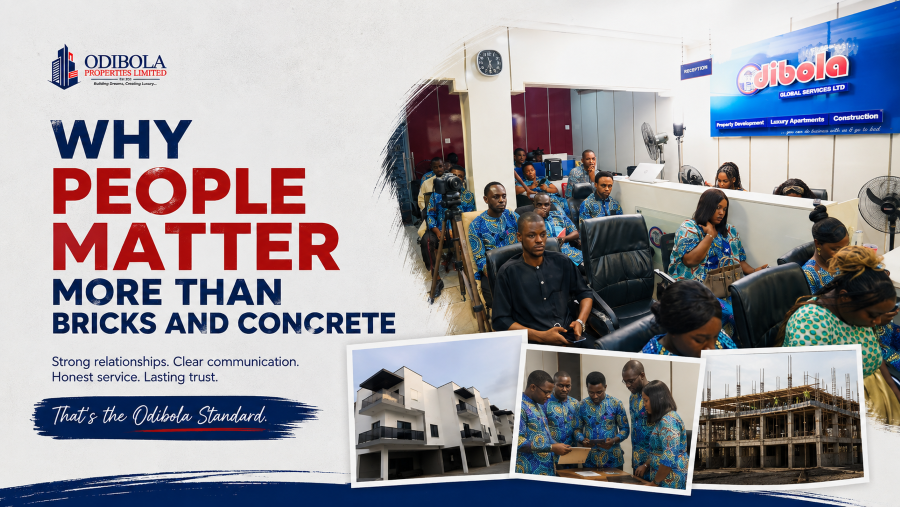
At Odibola Properties, we believe the relationship with a client deserves the same attention as the property itself.
Because a transaction can end with a payment.
A relationship does not have to.
The strongest companies understand this.
They do not only ask, “How do we sell this property?”
They also ask:
“How do we serve the person who has trusted us with their investment?”
That is where lasting value begins.
And ultimately, buildings may introduce people to a property company.
People determine whether they stay.